Inverse analysis of TRC
Inverse analysis · textile reinforced concrete · strain-based
Back-calculate the tension law of a textile reinforced concrete (TRC) laminate from the load-deflection curve of a thin plate in four-point or three-point bending. The tension law of a TRC is strain hardening: the textile carries load across many fine cracks long after the matrix has cracked, so the fitted curve rises to strains of several percent.
The TRC software. Patel, D., Pleesudjai, C., and Mobasher, B. (2025). Software for mechanical characterization and design of textile-reinforced concrete in flexure. Conference paper, Arizona State University.
The software. Patel, D., Pleesudjai, C., and Mobasher, B. (2026). An interactive inverse-analysis and design tool for reinforced UHPC beams. Fourth International Interactive Symposium on Ultra-High Performance Concrete, paper 44.
The TRC section model. Pleesudjai, C., and Mobasher, B. (2023). Analytical moment-curvature solutions for generalized textile-reinforced concrete sections. Engineering Structures, 276, 115317. doi:10.1016/j.engstruct.2022.115317 Recognized with the Elsevier Best Paper of the Year Award, Engineering Structures (2023).
TRC sandwich composites. Pleesudjai, C., Li, A., Dey, V., and Mobasher, B. (2021). Low-velocity impact experiments and modeling of TRC skin-aerated concrete core sandwich composites. Materials, 14(2), 390. doi:10.3390/ma14020390
What you need
- Plate dimensions, span, loading arrangement and the number of textile layers.
- The compressive strength of the matrix.
- The load-deflection record of one specimen as a two-column file.
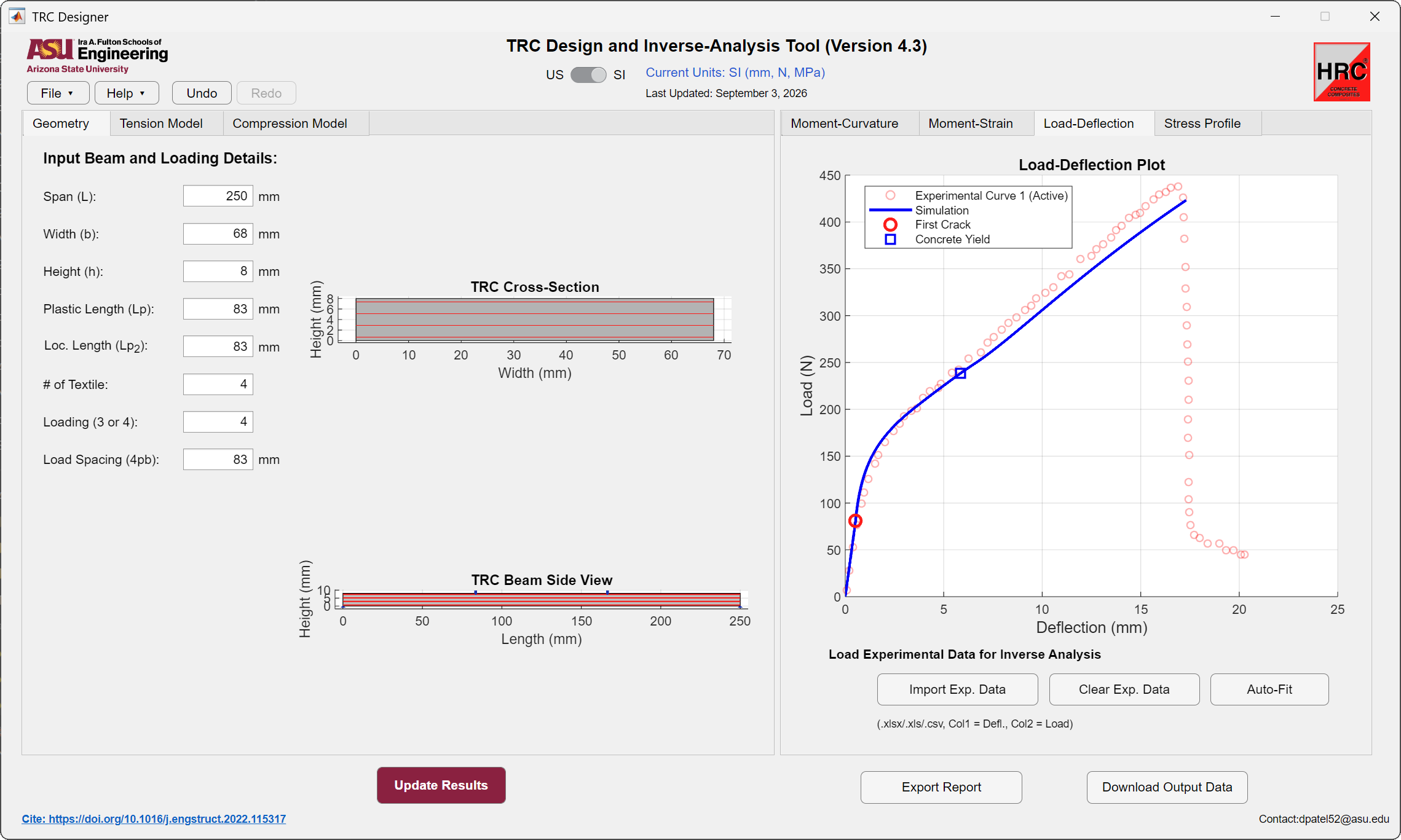
Step 1 · Geometry
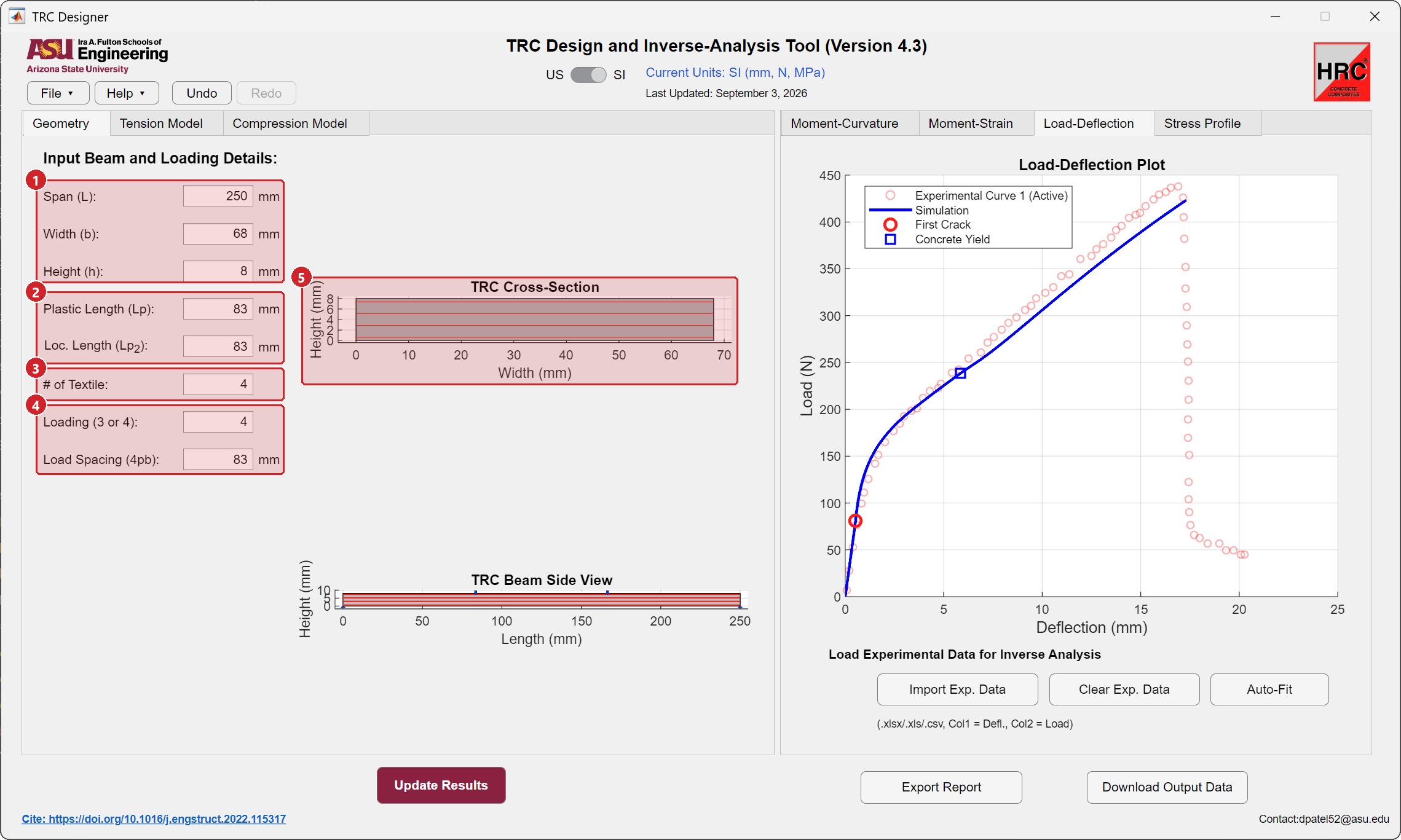
- Span, width and height. TRC specimens are thin plates; the height is the plate thickness.
- Plastic length and localization length. \(L_p\) is the zone of distributed cracking, \(L_{p2}\) the zone that localizes after the peak. Use the constant-moment zone for both in four-point bending unless the crack pattern of the test says otherwise.
- Number of textile layers, spread evenly through the thickness in the drawing.
- Loading and load spacing.
- The drawings of the section and the plate with its layers.
| Input | Symbol | Unit | Example |
|---|---|---|---|
| Span (L) | \(L\) | mm | 250 |
| Width (b), Height (h) | \(b, h\) | mm | 68, 8 |
| Plastic Length (Lp), Loc. Length (Lp2) | \(L_p, L_{p2}\) | mm | 83, 83 |
| # of Textile | count | 4 | |
| Loading (3 or 4), Load Spacing (4pb) | \(S_2\) | mm | 4, 83 |
| Input | Symbol | Unit | Example |
|---|---|---|---|
| Span (L) | \(L\) | in | 9.84 |
| Width (b), Height (h) | \(b, h\) | in | 2.68, 0.315 |
| Plastic Length (Lp), Loc. Length (Lp2) | \(L_p, L_{p2}\) | in | 3.27, 3.27 |
| # of Textile | count | 4 | |
| Loading (3 or 4), Load Spacing (4pb) | \(S_2\) | in | 4, 3.27 |
Step 2 · Tension model
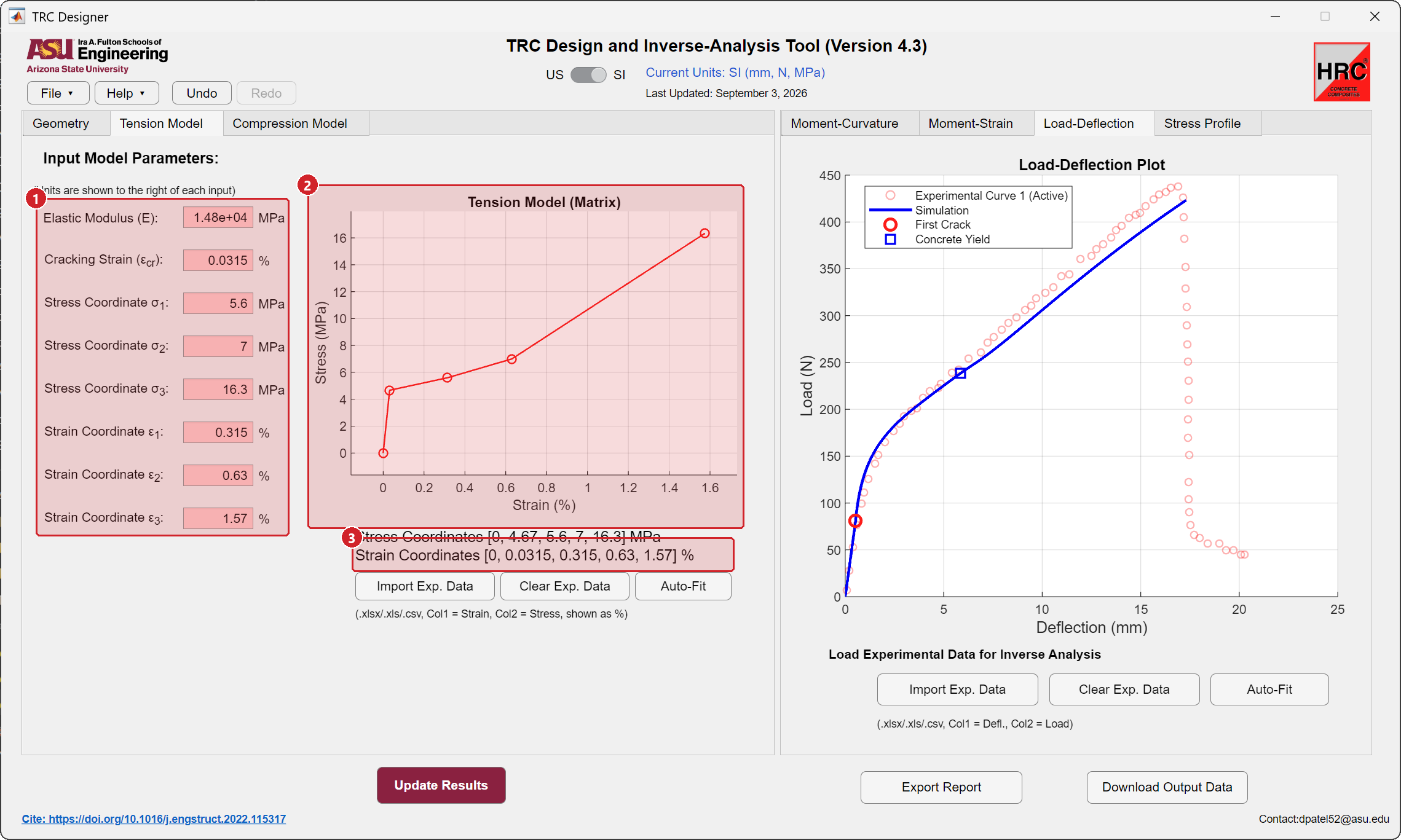
- The law. Modulus, cracking strain and three stress-strain coordinates, as in the ASTM C1609 module. For a TRC the stresses increase with strain and the last strain is the textile rupture strain, of the order of 1 to 2 percent.
- The plot. Drag a vertex to change the law.
- Import a direct tension test of the laminate to draw over the law, or fit the law to it with Auto-Fit on this tab.
Step 3 · Compression model
The Compression Model tab is the same as in the ASTM C1609 module. The matrix strength sets the compression law; TRC plates rarely reach compression yield before the textile ruptures.
Step 4 · Import and Auto-Fit
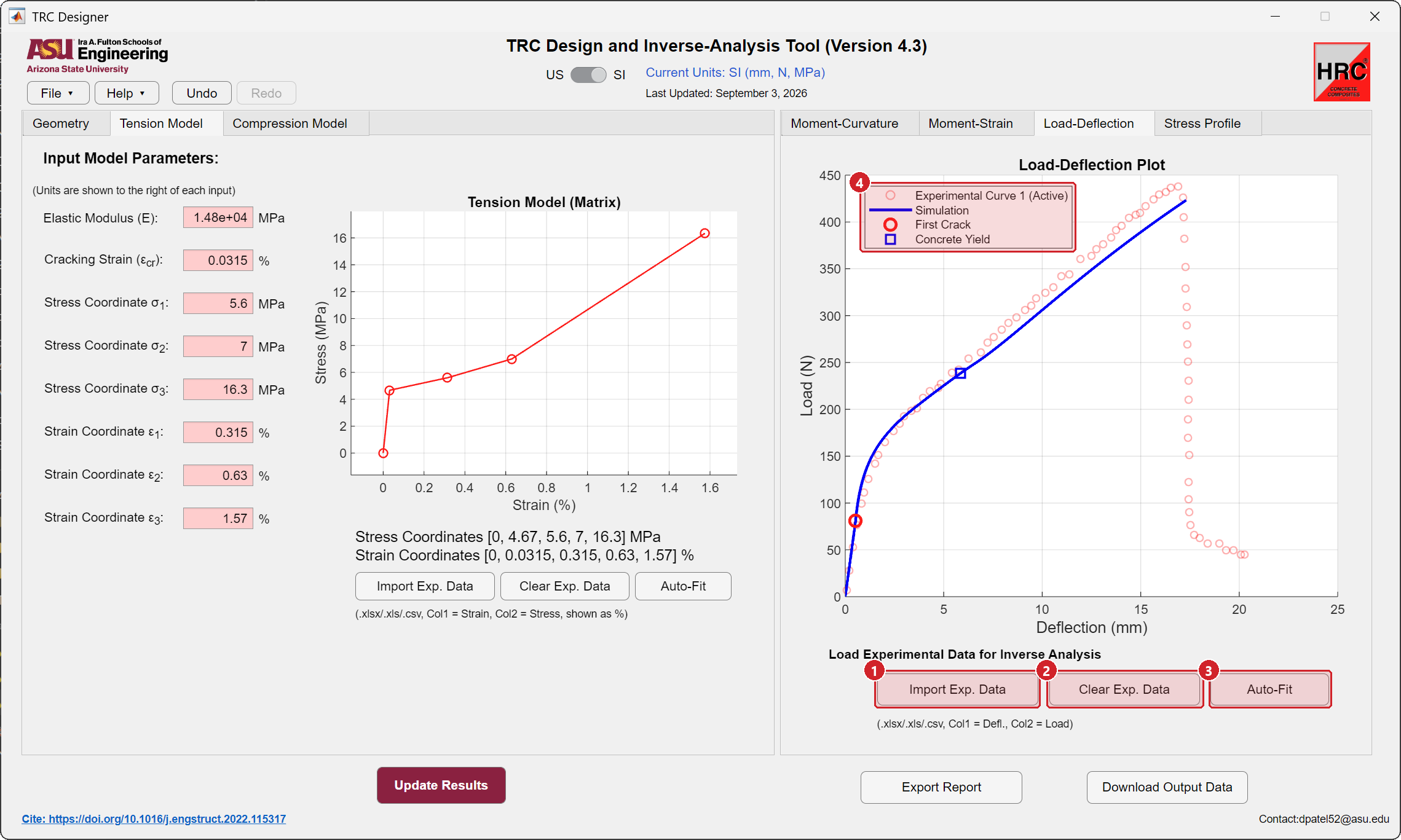
- Import Exp. Data. Two columns, deflection then load, in the current units.
- Clear Exp. Data removes the newest curve.
- Auto-Fit. The Auto-Fit Setup dialog asks for the modulus, then the solver fits the law to the active curve. A TRC fit takes longer than an FRC fit because the strain range is wider.
- Legend. Test, simulation and the limit states reached: first crack, concrete yield, concrete ultimate.
Seed the fit
Start from a law that already rises: a first coordinate near the cracking stress and a last coordinate at the expected rupture strain of the textile. The solver keeps the typed law as one of its seeds, and a good seed shortens the search.
Step 5 · Results and export
The Moment-Curvature, Moment-Strain and Stress Profile tabs and the Export Report, Download Output Data and File → Save commands work as in the ASTM C1609 module. The output workbook carries the fitted law into the design modules through Import Material.