Closed-form moment-curvature
Background · 2 of 5
The section is solved by imposing the tensile strain at the bottom fiber and increasing it step by step. At every step the neutral axis follows from force equilibrium, and the moment and curvature follow from the neutral axis. Because every material law is piecewise linear, each step has a closed-form answer.
The moment-curvature model. Pleesudjai, C., Patel, D. D., and Mobasher, B. (2023). Generalized nonlinear moment-curvature model for serviceability-based design of hybrid reinforced concrete. Journal of Structural Engineering, 149(12), 04023188. doi:10.1061/JSENDH.STENG-12235
Formulation and limit states. Patel, D. D., Pleesudjai, C., Neithalath, N., and Mobasher, B. (2026). Limit-state based design of hybrid reinforced UHPC flexural beams using parametric modeling. Engineering Structures, 357, 122353. doi:10.1016/j.engstruct.2026.122353
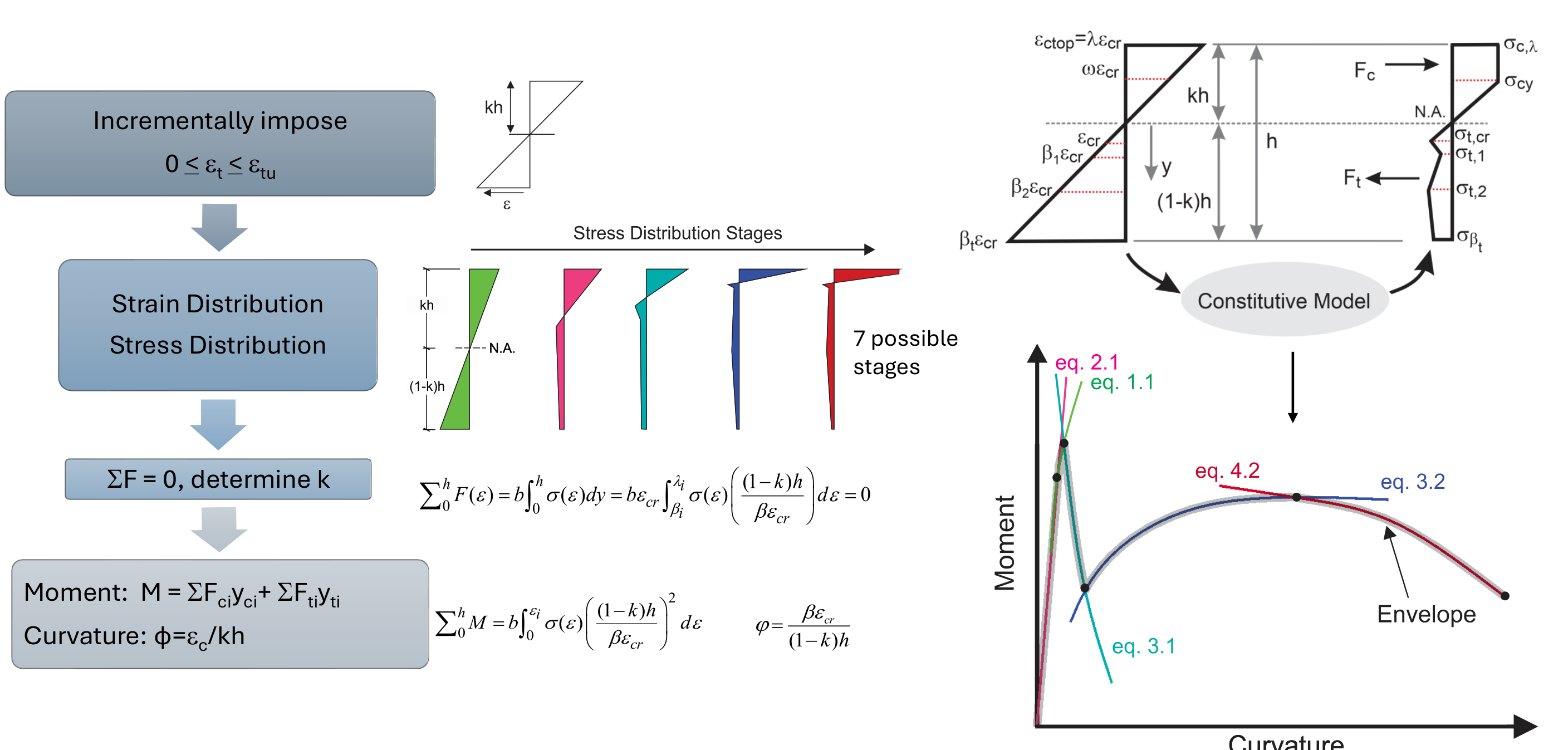
The three equations
With the bottom tensile strain \(\varepsilon_t = \beta\,\varepsilon_{cr}\) and the neutral axis at depth \(kh\), plane sections give the strain at any height \(y\) and the material laws give the stress. Equilibrium of the internal forces fixes \(k\):
The moment is the first moment of the same stresses about the neutral axis, and the curvature is the strain gradient:
For piecewise-linear laws every integral is a polynomial in \(k\), so the equilibrium equation is quadratic or lower and is solved without iteration. The software normalizes the moment by the cracking moment \(M_{cr} = \tfrac{1}{6} b h^2 \sigma_{cr}\) and the curvature by \(\phi_{cr} = 2\varepsilon_{cr}/h\).
Stages
As \(\beta\) grows, the bottom fiber moves from the elastic branch into the post-cracking branches, the top fiber may reach compressive yield, and each rebar layer may yield. Every combination is a stage with its own closed-form pair \(k(\beta)\), \(M(\beta)\). The software evaluates all stages that are admissible at a given \(\beta\) and keeps the one that satisfies equilibrium, which produces the envelope shown in the figure above. A plain FRC section has 7 stages. A hybrid section with tension and compression rebar has up to 14. The stage boundaries are the limit states listed on the Moment-Curvature tab: first crack, compression yield, rebar yield, crushing and rupture.
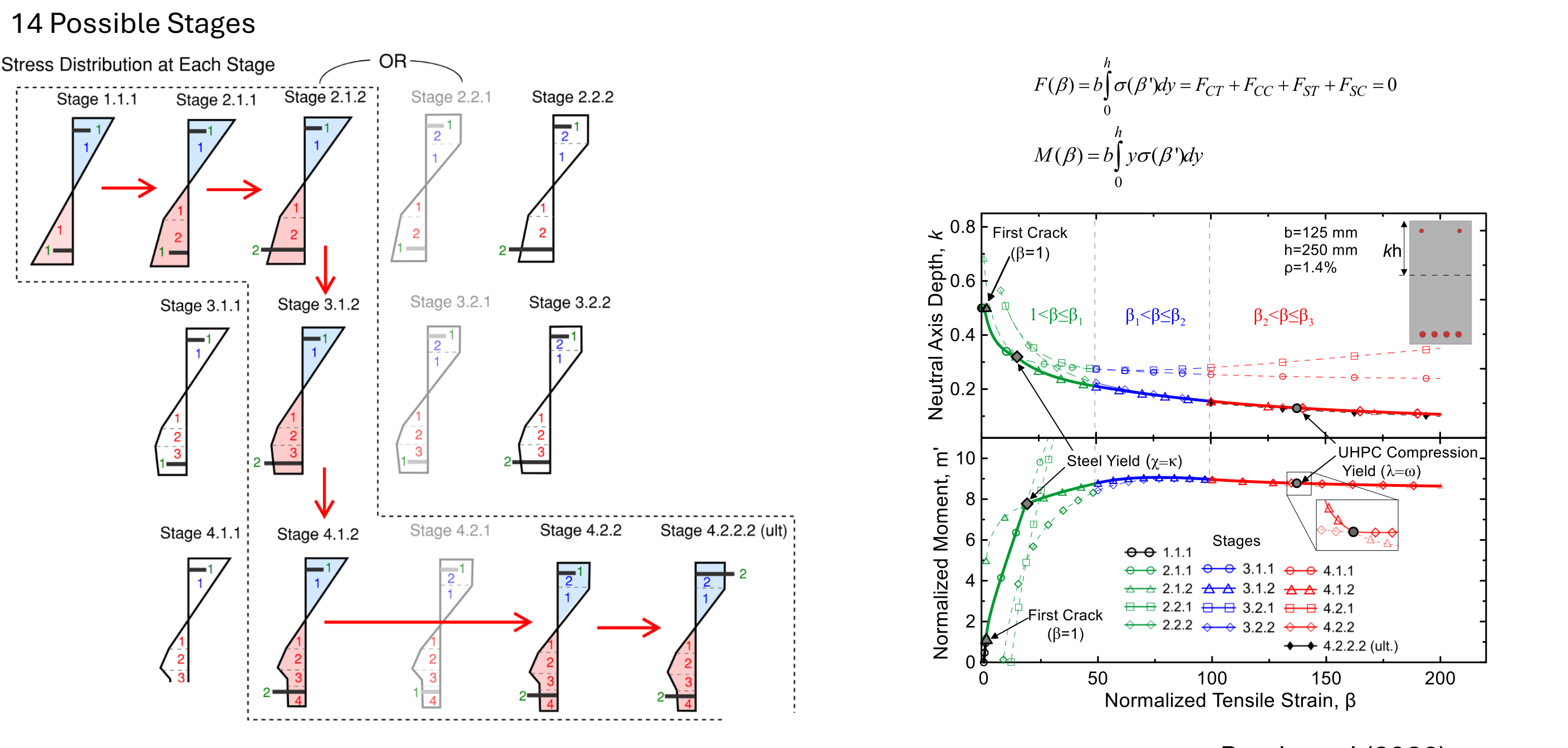
What the tabs show
- Moment-Curvature. \(M\) against \(\phi\), with the limit states marked and listed.
- Moment-Strain. \(M\) against \(\beta\) or the bottom strain in percent, colored by the tension zone of the bottom fiber. It shows which coordinate of the tension law governs each part of the curve.
- Stress Profile. The strain and stress distributions through the depth at a chosen \(\beta\), with the neutral axis. The Force Profile tab of the design modules adds the resultant forces in the concrete and reinforcement.
Cross-sectional module
The Cross-Sectional Analysis module keeps the same material laws but replaces the closed form by a fiber discretization of an arbitrary polygon and solves equilibrium numerically at each curvature, with an axial load. This is what allows any shape, any number of rebar layers, prestressing tendons and the P-M interaction diagram. See Cross-sectional analysis.